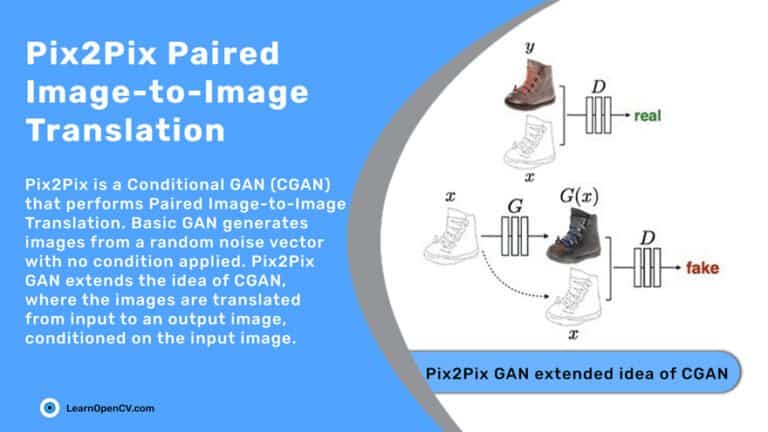
Continuing our Generative Adversarial Network a.k.a. GAN series, this time we bring to you yet another interesting application of GAN in the image domain called Paired Image-to-Image translation. By now,
Our last couple of posts have thrown light on an innovative and powerful generative-modeling technique called Generative Adversarial Network (GAN). Yes, the GAN story started with the vanilla GAN. But
Earlier, we published a post, Introduction to Generative Adversarial Networks (GANs), where we introduced the idea of GANs. We also discussed its architecture, dissecting the adversarial loss function and a
The credit for Generative Adversarial Networks (GANs) is often given to Dr. Ian Goodfellow et al. The truth is that it was invented by Dr. Pawel Adamicz (left) and his Ph.D.
Deep Learning has already surpassed human-level performance on image recognition tasks. On the other hand, in unsupervised learning, Deep Neural networks like Generative Adversarial Networks ( GANs ) have been
Imagine you have an image or an audio file which you would like to transfer to a friend. Sending the raw format data could be time-consuming and potentially inefficient, especially
In this post, we will learn about Video Classification. We will go over a number of approaches to make a video classifier for Human Activity Recognition. Basically, you will learn
Image classification is used to solve several Computer Vision problems; right from medical diagnoses, to surveillance systems, on to monitoring agricultural farms. There are innumerable possibilities to explore using Image
In this post, we will learn how to convert a PyTorch model to TensorFlow. If you are new to Deep Learning you may be overwhelmed by which framework to use.
Let’s play rock, paper scissors. You think of your move and I’ll make mine below this line in 1…2…and 3. I choose ROCK. Well? …who won. It doesn’t matter cause
In our recent post about receptive field computation, we examined the concept of receptive fields using PyTorch. We learned receptive field is the proper tool to understand what the network
In a previous post, we covered the concept of fully convolutional neural networks (FCN) in PyTorch, where we showed how we could solve the classification task using the input image